
Undoubtedly, online shopping sites like Amazon, eBay, and others have made things easier for shoppers. Amazon has more than 300 million active buyers worldwide, making it the most popular marketplace app. Amazon gets nearly 197 million new shoppers and visitors each month.
When entrepreneurs saw Amazon’s success, they decided to make their multi-seller marketplace apps. But to make a multi-vendor marketplace app, you need to include the right features and use the right strategies.
What Does It Mean to Talk About a “Marketplace App”?
To be as big as Amazon in the market, you need to be an expert at making apps for marketplaces with many sellers. A “digital marketplace” is a place on the Internet where buyers and sellers can meet and do business with each other. These apps aim to organize and coordinate different groups of people and give them a place to buy and sell things that follow all the rules.
The Marketplace app makes it easy to buy things online from a phone, tablet, laptop, or desktop computer. Also, the amount of information in these apps depends on the products being promoted, the size of the promotions, and how many products are being promoted. In reality, the most successful e-commerce apps, like Amazon’s, also put customer satisfaction first by addressing common complaints and finding long-term solutions.
An online marketplace is a platform for both sellers and buyers to join together in massive numbers. It works as the intermediary between different groups, offers a feasible environment and required guarantees. A marketplace app is slightly different from an online store.
A marketplace app is created for easy and smooth shopping on a device like a mobile or a tablet. These apps are different as per the type of products they offer, the size, and the way they advertise themselves. Marketplace apps like Amazon fix all issues that shoppers have with online buying apps.
What happens when you use the app for the online market?
- Apps bring buyers and sellers together on online markets like Amazon. In the digital world, they act as middlemen between buyers and sellers to ensure everyone has a good time. As a result, consumers can choose from a wide range of products made by different companies.
- Because Amazon has flexible business terms, many well-known brands choose to sell their products there. Because of this, more people use this app than its competitors.
- Because of the current pandemic, more people are using marketplace apps to buy things. Customers can also choose from a wide range of items that make life at home easier. The goods are brought to the customers’ front doors as part of the services. But brands, not apps, are in charge of keeping track of things like stock, shipping information, product photos, etc.
- Also, these marketplace apps give brands a separate way to keep track of orders and stock. Then, in an expert setting, visitors can look at what’s for sale and read the most recent reviews.
How Do Online Marketplaces Work?
Online marketplaces congregate buyers and sellers through apps like Amazon. While acting like digital middlemen, they bring buyers and sellers together to make transactions efficiently. Buyers can choose what to purchase and sellers can offer various products to customers.
Because of the convenience Amazon offers, it is driving internet economies all across the world. By driving liquidity via commissions, value-added services, and advertising, online marketplaces have become the cash cow of different companies. These platforms have replaced all web sectors in terms of online traffic growth.
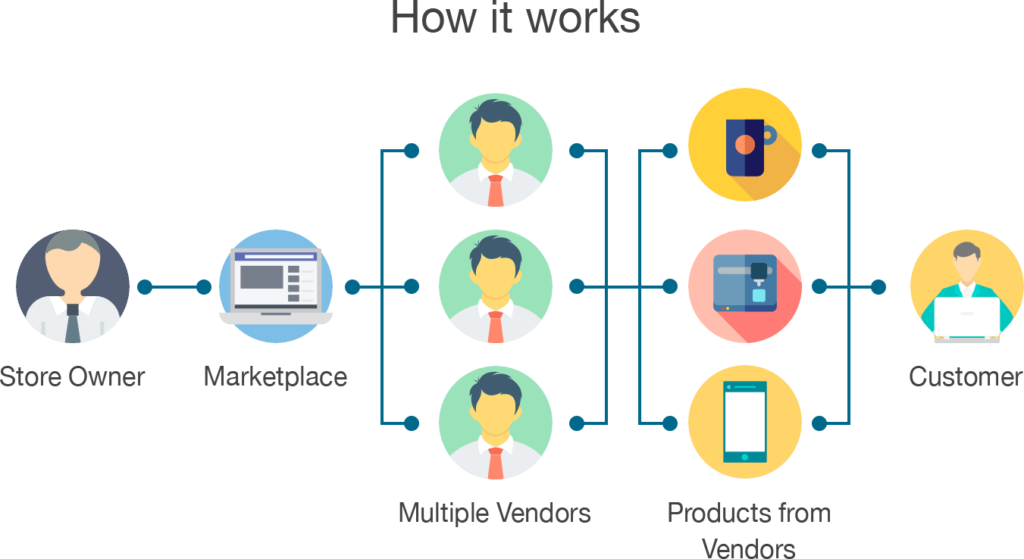
These days, customers have more faith in online marketplaces as they offer a wide variety of products from both small and large sellers worldwide. Online marketplaces don’t need to maintain product descriptions, logistics, inventories, and product images as the responsibility is on the sellers.
Sellers also get a fixed space for handing their orders and selling stuff. Buyers access the online inventory and check the real-time data about the goods that are updated timely.
Different Types of Online Marketplaces
Following are the major types of online marketplaces based on core focus:
Horizontal Marketplace
Horizontal marketplace sells many products and services to a wide range of customers across different industries. This marketplace follows the concept of one-stop shop, fulfilling various customer needs in one place. Most famous marketplaces like Amazon, eBay, AliExpress are the best examples for this category.
Vertical Marketplace
Vertical marketplace is based on a specific niche. This type of marketplace offers a range of products from several vendors but of a similar type. Thereby, a vertical marketplace can enhance customization and be different from others who sell many goods. Etsy is a good example of this marketplace that usually sells vintage and handmade products.
Following are the types of marketplaces based on their target audience:
Business-to-customer Marketplace
Business-to-customer or B2C marketplace is a platform where sellers sell goods to consumers. Some common examples include Flipkart, and Amazon.
Business-to-business Marketplace
Business-to-business or B2B marketplace where wholesale suppliers sell goods to other businesses at a wholesale rate. Walmart and Alibaba are common examples.
Customer-to-customer Marketplace
Customer-to-customer or C2C marketplace is a platform where consumers sell goods to other consumers. A well-known example is Etsy.
Must-Have Features of Marketplace Apps
To develop a marketplace app like Amazon successfully, ensure to add most of these features:
1. Seamless Registration Process
An easy registration process can retain many users on a marketplace app. You need to keep the entire registration process as easy and small as possible so the users don’t need to wait patiently to use your app.
2. Social Media Integration
Integrating your app with social platforms is one of the best ways to allow users to use your marketplace app. Apart from the one-touch login facility, the users must get access to your app with only a few clicks through Facebook, Twitter, Gmail, and other different social platforms.
3. Advanced Search Options
This essential yet simple feature helps you sell your goods efficiently. With effective and advanced search options, users can get many options.
4. Voice Search
This feature is going to transform the search for products and services soon. You must optimize this feature the way that the products’ info must be compatible with the voice search parameters.
5. Add to Cart
Add this feature to your marketplace app for the consumers who sometimes don’t buy a product immediately but like the add-to-cart option to save the product for future buying.
6. Multiple Payment Choices
Each and every customer has a different payment choice. Hence, use various payment gateways to offer multiple payment choices to your consumers.
7. Push Notifications
Push notifications keep reminding the users of what products they are missing. This is the best way to keep them stuck with your marketplace app. The application of the right push notification methods defines your app’s success. Hence, spend on a good push notification system to retain your customers.
8. Ratings & Reviews
These features are necessary if you want to develop a marketplace app like Amazon. It adds a trust element in the genuineness of your products and services. Moreover, it helps consumers make a detailed buying decision while helping you understand the things that you need to work on.
9. Photo Shopping
This feature helps buyers find a product even without knowing the brand or the product name. They can just use the picture to search for a product. Presently, many online biggies are using this feature.
10. Augmented Reality
Integrate your marketplace app with AR technology. It helps your app offer visitors the scope to analyze the products and services visually before finalizing the payment.
Now that you know the must-have features, explore some other features of the marketplace app for Users, Sellers, and Admin. Let’s have a look!
Key Features of Marketplace App For Users
- Product listing
- Product description page
- Favorites listing
- User profile
- Social sign-up and login
- Questions & Answers
- Add to cart
- Shipping and billing addresses
- Checkout page
- Order tracking and history
- Delivery status
- Ratings and reviews
Key Features of Marketplace App For Sellers
- Social sign-up and login
- Offers and discounts
- Notifications
- Inventory management
- Settlement module
- Reports and analysis
- Feedback and seller support
- Order and return management
- Ratings and reviews
Key Features of Marketplace App For Admin
- Reports and analysis
- User and admin management
- Category management
- Feedback and support
- Seller and product management
- Payment and refund management
- Discounts and offers management
- Banner and logistics management
How to Develop a Marketplace App like Amazon?
Amazon is a successful example for every eCommerce startup. This marketplace giant serves an attractive UI and multiple engaging features. In case you want to develop a marketplace app like Amazon, follow these steps mentioned below:
1. Research & Planning
Without proper research and planning, you may make mistakes while developing a marketplace app. While creating a marketplace app, assess your customers’ needs and behaviors, decide what type of goods you want to sell, and categorize your products precisely so your consumers can find them easily.
2. Select the Platform to Launch Your App
Next, you need to choose the right platform for launching your app. Apple App Store and Google Play Store are the prominent options in the market. Decide whether you will target users on a specific platform or use multiple platforms for targeting a large number of users.
To choose the best platform, understand your consumers’ Geolocation, determine the time to develop the app, and decide your customers as rich people usually use iPhones and a large number of middle-class consumers choose Android.
3. Decide The App Features
Features decide the future possibilities of your app. So, apart from making your app look attractive, make your app easy to use, simple, and hassle-free. This will help you convert a visitor into a promising customer. You can create an app with MVP to reduce the development cost.
4. UI/UX Design
UI/UX design is an essential thing to allure users and inspires them to invest in your app. Keep the app design simple so the users don’t feel tough to access the functionality. Ensure to select soothing visuals, schemes, and colors to offer a pleasant experience to your users.
5. Choose the Technology Stack
Selecting the right technology stack for a mobile app development project is imperative, and it should be done very carefully. To build a marketplace app, use the following technologies:
6. Hire a Skilled Team of Experts
To create your Amazon-like marketplace app, hire a skilled team of developers. Your team needs many individuals like business analysts, project managers, front-end developers, backend developers, UI/UX designers, Android and iOS app developers, and QA experts.
7. Decide the Final Development Cost
Every business has a distinct demand and various factors impact the mobile app development cost. Hence, it’s tough to assess the precise cost of developing a marketplace app. However, you can decide the closer estimation of the ultimate cost by assessing the whole process.
How Does a Marketplace App Make Money?
There are multiple revenue models, such as affiliate revenue, and transaction charges revenue. In terms of the affiliate model, you can get a commission for referring the consumers to other apps after building your marketplace app.
Selling is not the single way to make money for your marketplace app. Here are some common revenue generation models for a marketplace app like Amazon:
1. Product Listing Fees
By listing your products, you can monetize your marketplace. Different online marketplaces like eBay and Amazon depend on this monetization model.
2. Sales Commission
By earning commissions from vendors on every sale, you can make money. Choose a percentage per successful sale. Marketplaces like Etsy and Amazon follow this monetization model for revenue generation.
3. Subscription or Membership
Offering subscription-based services helps you monetize your marketplace app. In this model, you can sell subscriptions to your consumers, and as a result, offer them additional advantages. Such advantages could be free delivery, same-day delivery, next-day delivery, etc.
4. Advertisement
Putting ads on your app is another great way to create revenue. Join an ad network like Google Ads and let it enable you to display ads on your app. Choose an advertising model like CPC (Cost per Click) or CPM (Cost per Mile) to produce revenue through your marketplace app.
5. Sponsorship or Partnership
You can team up with other marketplaces. New businesses always look for ad space to get more recognition. So, provide them such space on your app and charge for the partnership or the sponsored content.